


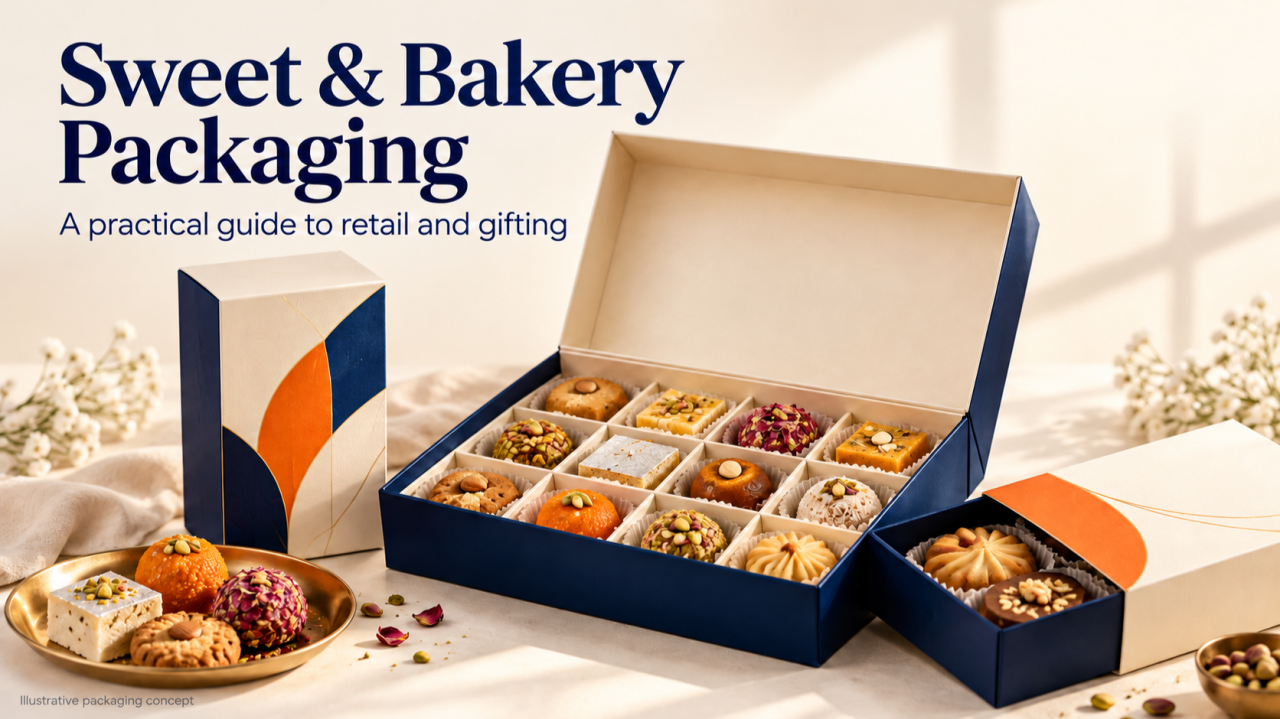
A well-made sweet or bakery box should arrive at the counter ready to do a practical job: hold the intended assortment, close neatly, remain comfortable to carry and present the product clearly. Its appearance matters, but the buying decision becomes easier when the product and the way it will be sold are defined first.
For sweet shops, bakeries, chocolatiers and gifting businesses, custom packaging often serves several situations at once. A daily takeaway order may need quick assembly. A wedding assortment may need consistent presentation across many boxes. A corporate gift may need space for a message card and careful organisation inside.
This guide explains how to choose a suitable structure, plan the interior, review print finishes and approve a sample before ordering. The aim is to give your packaging supplier a brief that can be quoted and checked, rather than a photograph that leaves important decisions open.
1. Start with the product and the handover
Before selecting colours or browsing box styles, write down exactly what each pack will contain. Include the number of pieces, their approximate dimensions, the total filled weight and any cups, wrappers or inner containers already used. Measure the actual packed arrangement, including decorations and toppings that must remain untouched.
A mixed assortment needs particular attention. A tall cupcake, a delicate biscuit and an individually wrapped chocolate have different space and support requirements. Even two sweets with similar weights may occupy very different volumes. A box described only as a half-kilogram pack does not tell the designer enough about the arrangement.
Next, describe the route to the customer. Will staff fill the box while the customer waits? Will orders be packed ahead of collection? Will a delivery partner carry several orders together? Will the presentation box sit inside another protective pack for shipping?
These answers help establish the operating requirements. A retail team may value an easy closure and clear size identification. A gifting team may prioritise a tidy opening experience and a place for a card. A delivery order needs the complete packed arrangement evaluated for its actual handling conditions.
Separate these uses in the brief. One structure may serve several of them, but that should be demonstrated with a sample rather than assumed from its appearance.
2. Match the box format to the buying occasion
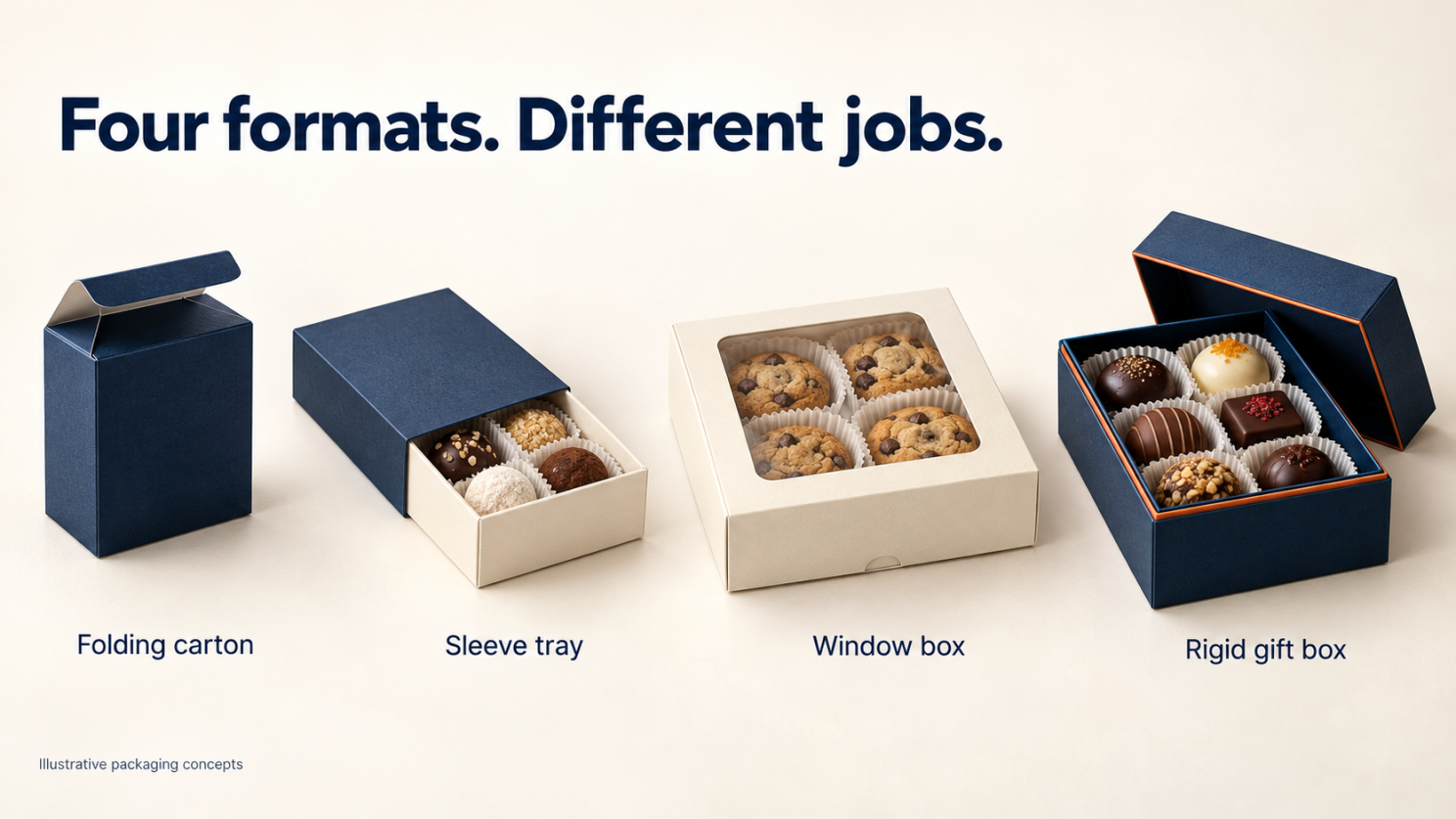
Eagle Print Care's sweet and bakery packaging range includes folding cartons, sleeve trays, handle boxes, window packs and rigid presentation boxes. These provide different starting points for a custom project. The final choice still depends on the contents, assembly process and intended presentation. (Eagle product guide)
Folding cartons for everyday retail
A folding carton is worth exploring when the team needs a printed pack that can be assembled for routine orders. Ask to see how the proposed base locks, how the lid closes and how the box behaves when filled. Confirm whether it arrives flat, partly assembled or ready to use, because that affects storage and preparation at the shop.
Sleeve trays for an organised reveal
A tray with an outer sleeve can give an assortment a controlled opening sequence. Check that the filled tray slides smoothly and remains supported during opening. The customer should have a clear way to grip it. Ask the supplier to demonstrate the closure and retention arrangement with the intended contents inside.
Window boxes for visible presentation
A window can make the arrangement part of the exterior display. Position it around what the customer should see, whether that is a decorated bakery item or a neatly ordered assortment. Review the visible edges, the window attachment and the surrounding board on a physical sample. A larger opening is a design choice to evaluate, not an automatic improvement.
Rigid boxes for planned gifting
A rigid presentation box may suit an assortment where the opening experience is central to the gift. Review the lid fit, interior depth and handling of the filled box. Compare the storage and transport space it needs with your available space. Choose the format because it serves the occasion and workflow, rather than because it looks expensive in a reference image.
3. Design the interior before finalising the exterior
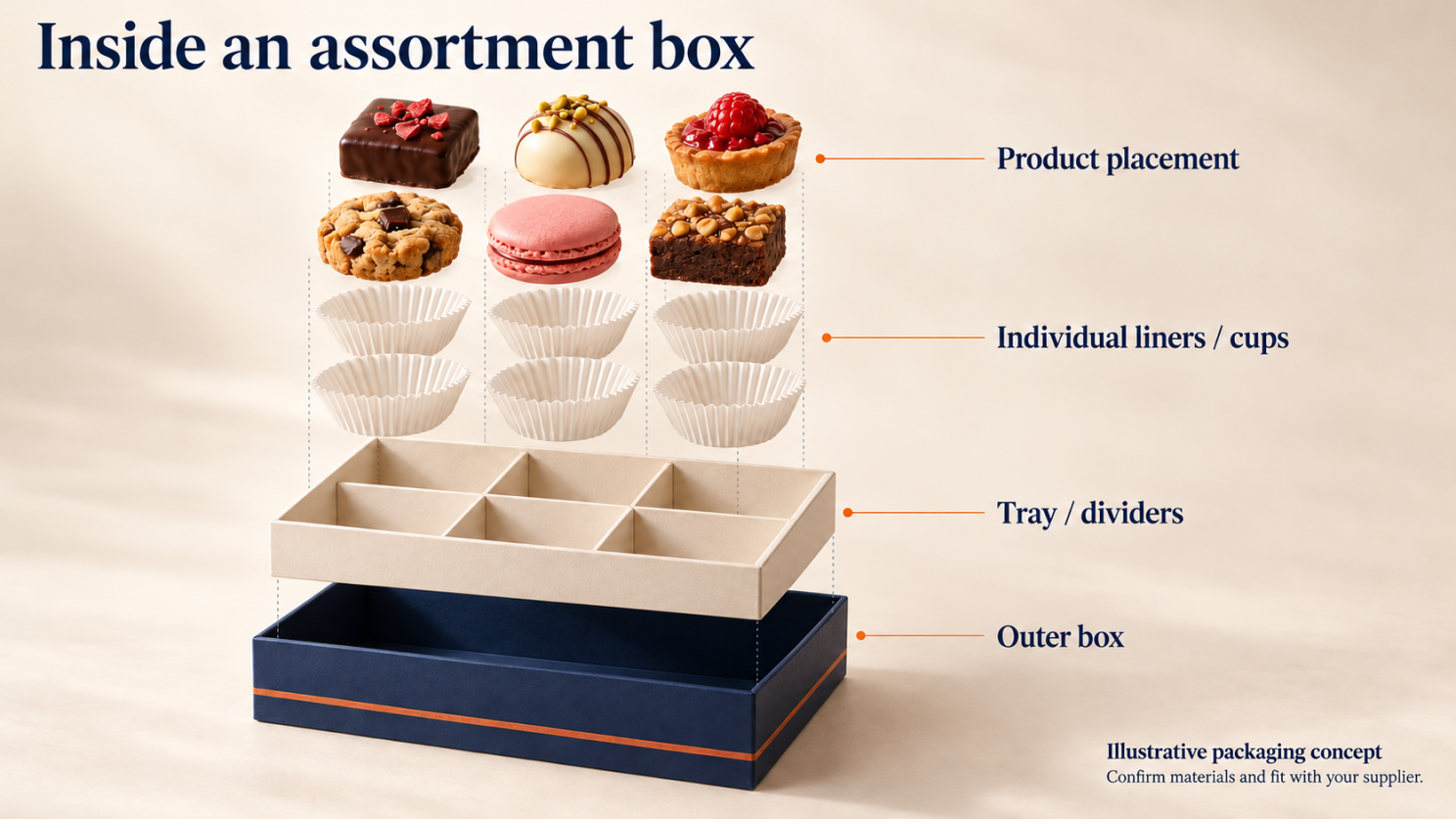
An attractive outer box can still disappoint if the contents move into an untidy arrangement. Work from the inside out: define the product positions, identify the required separation and then agree the overall box dimensions.
For each compartment, check how the product is placed and removed. The fit should allow staff to load the item without crushing an edge or scraping a topping. Customers also need a practical way to lift it out. Include the intended cup, wrapper or liner in every fit check.
Dividers, trays and platforms can help organise the assortment, but every extra component adds something to purchase, store and assemble. Ask which components are essential and which are mainly decorative. Trial the proposed arrangement with the people who will actually pack orders.
Pay attention to the view when the lid opens. Uneven gaps, a hidden item or a card placed over delicate decorations can make the assortment feel unfinished. A plain structural prototype is useful here because the team can judge the arrangement without being distracted by artwork.
4. Confirm material requirements for the intended food
Food packaging material selection needs more information than a preferred colour or board thickness. Tell the supplier whether the food will touch the packaging directly, what individual wrapping is used and whether grease, moisture or refrigeration forms part of the intended use.
Eagle's product guidance specifically asks buyers to confirm direct food contact and storage requirements before material selection. Treat that conversation as an early design input. Request documentation appropriate to the proposed materials, food and market from the responsible supplier. (Eagle product guide)
Do not judge suitability from a white surface, a kraft appearance or a decorative coating. A retail presentation sample can show layout and workmanship; it does not establish the suitability of every material for every food. Confirm the complete arrangement, including inner components and the intended conditions of use.
If the assortment changes later, revisit the specification. Moving from wrapped chocolates to unwrapped sweets, for example, changes the contact arrangement. A packaging order should identify the approved use clearly enough that a repeat order does not depend on someone remembering an earlier conversation.
5. Use print and finishing with a clear hierarchy
Start the artwork with the information the customer needs to recognise. Establish the brand name, product or assortment name and the principal display panel. Allocate the remaining information deliberately, including any product-specific content that your business must verify for the relevant market.
Leave suitable space for variable details that will be applied at packing. Ask where labels will sit, how staff will orient them and whether the chosen surface will work with the intended application method. A beautiful front panel loses clarity when an unplanned sticker covers the main design.
Finishing should support this hierarchy. A restrained foil detail or embossing treatment may emphasise a brand element, while a generous area of clear print can keep the product name easy to read. Eagle lists foil, embossing, lamination and other finishing capabilities; the appropriate combination should be agreed for the specific pack. (Eagle capabilities)
Check the assembled box, including corners and folds. Holmen's paperboard guidance explains that suitable creasing supports distinct folds and helps avoid surface cracking. This is a useful reason to review a converted sample instead of approving appearance only from a flat artwork file. (Holmen creasing guidance)
Look at the sample under ordinary shop lighting as well as in a design review. Confirm that fine text remains legible and important information is not hidden when the pack is closed, stacked or held by its handle.
6. Approve a sample through the real packing routine
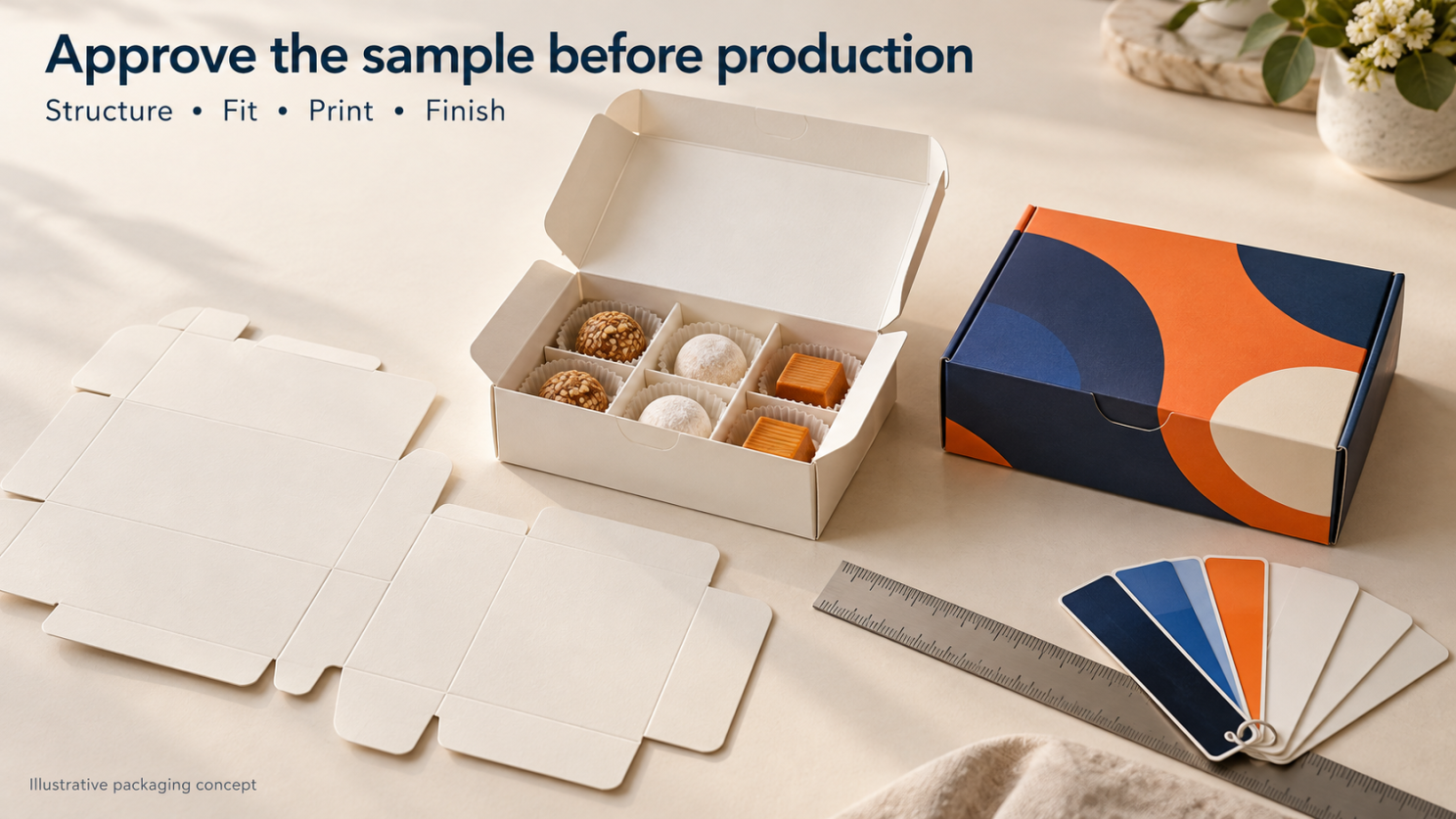
Give different approval stages clear names. A plain structural sample helps check dimensions, assembly and arrangement. A print proof helps review artwork content and placement. A sample representative of the proposed finished construction allows a broader review. Ask the supplier what each sample represents and what remains unverified.
Use the actual intended contents and accessories for the trial. Pack several boxes using the planned routine, then observe where the team hesitates. Does the base take too long to form? Do dividers require adjustment? Does a label land across a closure? Are different sizes easy to identify?
Use a short approval record:
Confirm the assortment, arrangement and filled weight used for the check.Record the agreed internal dimensions and included components.Check assembly, closure, opening and customer access to the contents.Review printing, finishing and information placement on the assembled pack.List the intended handling and storage conditions discussed with the supplier.Record the approved sample and artwork versions, with any remaining changes.
A hand-carry check can reveal a practical problem, but it should not be represented as formal transport validation. If the order will travel through a delivery or shipping network, discuss the necessary evaluation of the complete packed system for that route.
7. Compare quotations on the same specification
When requesting prices, give every supplier the same description of the pack. Identify the structure, dimensions, components, print coverage, finishes, quantities and delivery destination. State whether the quotation should include sampling, tooling and other one-time charges.
Separate each size and artwork variant. A total requirement spread across several designs may be treated differently from one design ordered in a single quantity. Ask the supplier to state the quantity assumptions rather than comparing headline prices that cover different work.
Also confirm the delivery form. Flat cartons, assembled boxes and separate inserts create different receiving and packing routines. Review how the goods will be bundled and identified so the shop can distinguish similar variants without opening every bundle.
Build the schedule around approvals. Ask when the final structure, artwork and any variable information must be confirmed. A requested delivery date becomes more useful when both teams understand what needs to be decided before production can begin.
8. An illustrative example of one bakery with two needs
Consider a bakery planning an everyday biscuit assortment and a celebration gift using the same biscuits. This is an illustrative planning example, not a client case study or a claim about results.
For everyday sales, the team begins by arranging the intended pieces in their individual inner packaging. It trials a folding carton that staff can assemble at the counter. The review focuses on access, closure and whether the front label remains visible after packing. The team records the arrangement so each order is presented consistently.
For the gift version, it explores a presentation box with a defined internal layout and a message card. The card is given its own position rather than resting loosely over the biscuits. The supplier is asked to show how the filled box opens and how the inner arrangement is supported.
Both versions share the same brand identity, but each has its own specification and approval record. The everyday box is assessed around counter service; the gift box is assessed around presentation and the planned handover. The business can then compare costs and practical trade-offs without expecting one attractive mock-up to answer both briefs.
Questions buyers often ask
Which box is best for a mixed sweet assortment?
Begin with the actual arrangement, piece dimensions, filled weight and contact requirements. Then compare suitable structures using a physical sample. The name of a box style alone is not enough to establish the right fit.
Should every gift box have a window?
Use a window when seeing the product supports the buying experience. Review its position and size with the intended arrangement. A closed presentation box can be a better fit when the gift is intended to be revealed after opening.
Can we use one box for several pack sizes?
Explore that possibility with the supplier, including any different internal components. Check each intended arrangement separately. Any purchasing convenience should be weighed against packing work, product movement and the appearance of partly filled space.
What should we send for a custom quotation?
Send product photographs, piece dimensions, the intended count or weight, the packed arrangement, required quantity, artwork or brand references, expected use and delivery location. Include food-contact and storage requirements, plus the date by which the packaging is needed.
Preparing your next packaging brief
For a sweet shop, bakery or gifting business sourcing custom boxes in Karur, a useful first conversation begins with the product and a clear description of its journey. Agree the structure, interior and material requirements before refining the decorative details.
Eagle Print Care offers made-to-order sweet and bakery packaging with custom dimensions and presentation options. Share the intended assortment, quantity and reference images to discuss a suitable starting point. A clear brief and an approved sample give everyone a shared reference for the finished order. (Eagle product guide)
Sources
[1] Eagle Print Care — Custom Sweet & Bakery Boxes